


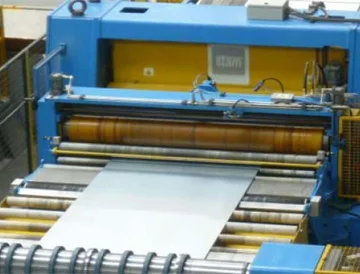
Longitudinal and transverse cutting
Slitting and cross-cutting of metal, also known as longitudinal and transverse cutting, is a combined process used to convert metal coils into flat sheets of specific dimensions. The coil is first slit into narrower strips (longitudinally), and then these strips are cut across (transversely) to the required length. This method is widely used in metal processing industries where high efficiency and precise sheet preparation are needed.
The process is carried out on slitting and cut-to-length lines, which typically include an uncoiler, a slitting unit (with rotary blades), a cross-cut shear, and a stacking system. The coil passes through the slitting blades to create strips, which are then cut across into flat sheets. The result is high-quality, accurately sized sheets ready for manufacturing or direct use.
Advantages of longitudinal-transverse cutting:
- Fully automated process with high throughput;
- Flexibility to produce different sheet sizes without changing the coil;
- Minimal waste and precise dimensions;
- Suitable for various metals like steel, aluminum, copper, etc.
This method is essential in construction, roofing, facade manufacturing, metal part production, and packaging. Slitting and cross-cutting is a cost-effective and scalable solution for large-scale operations requiring consistent quality and speed.