





Turning and carousel machining
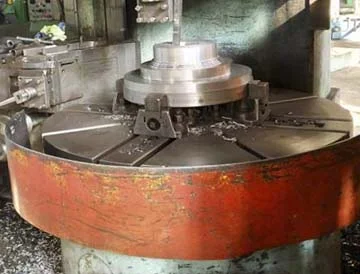
Vertical turning, also known as vertical lathe machining or vertical turret lathe (VTL) machining, is a specialized metal cutting process used for machining large-diameter and heavy workpieces. In this process, the workpiece is mounted horizontally on a rotating table (chuck), and the cutting tool moves vertically and radially to perform the turning operations.
Vertical turning is ideal for parts such as large flanges, rings, bearing housings, gears, and turbine components, especially those with significant mass and diameter. The vertical orientation allows gravity to assist in stabilizing the workpiece, reducing vibration and increasing machining accuracy.
Modern vertical turning lathes are often equipped with CNC (Computer Numerical Control) systems, which improve precision, repeatability, and efficiency, especially in batch production or complex geometries.
Key advantages of vertical turning:
- Efficient machining of large and heavy components;
- High rigidity and reduced vibration during cutting;
- One setup for both internal and external surfaces;
- Excellent accuracy and surface finish;
- Possibility of combining multiple operations (boring, facing, drilling) on one machine.
Vertical turning is widely used in industries like aerospace, energy, shipbuilding, heavy machinery, and automotive manufacturing where precision and capacity are critical.