




Turning and milling machining
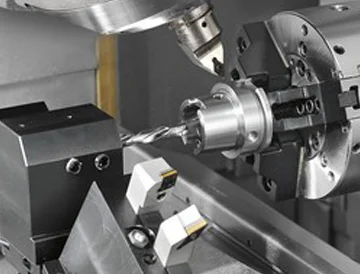
Turning and milling machining, also known as mill-turn machining, is a combined process that integrates both turning and milling operations on a single machine. This type of machining is performed on mill-turn centers, which are hybrid CNC machines capable of rotating the workpiece and using rotating tools for complex cutting.
In turning, the workpiece rotates while a cutting tool removes material to form cylindrical shapes. In milling, the cutting tool rotates to machine flat surfaces, slots, and holes. By combining these two operations, mill-turn machining allows for efficient and precise manufacturing of complex parts in a single setup.
Advantages of mill-turn machining:
- High accuracy and dimensional stability;
- Reduced setup time and fewer workpiece transfers;
- Capability to machine complex geometries in one process;
- Improved productivity and cost-efficiency;
- Lower risk of errors due to fewer manual operations.
Mill-turn centers are widely used in industries such as aerospace, automotive, medical equipment, tooling, and precision engineering — wherever there’s a need to produce high-precision, multifunctional parts with tight tolerances.